
I read your letter more times than I will admit. Now I need your answer, not your story.
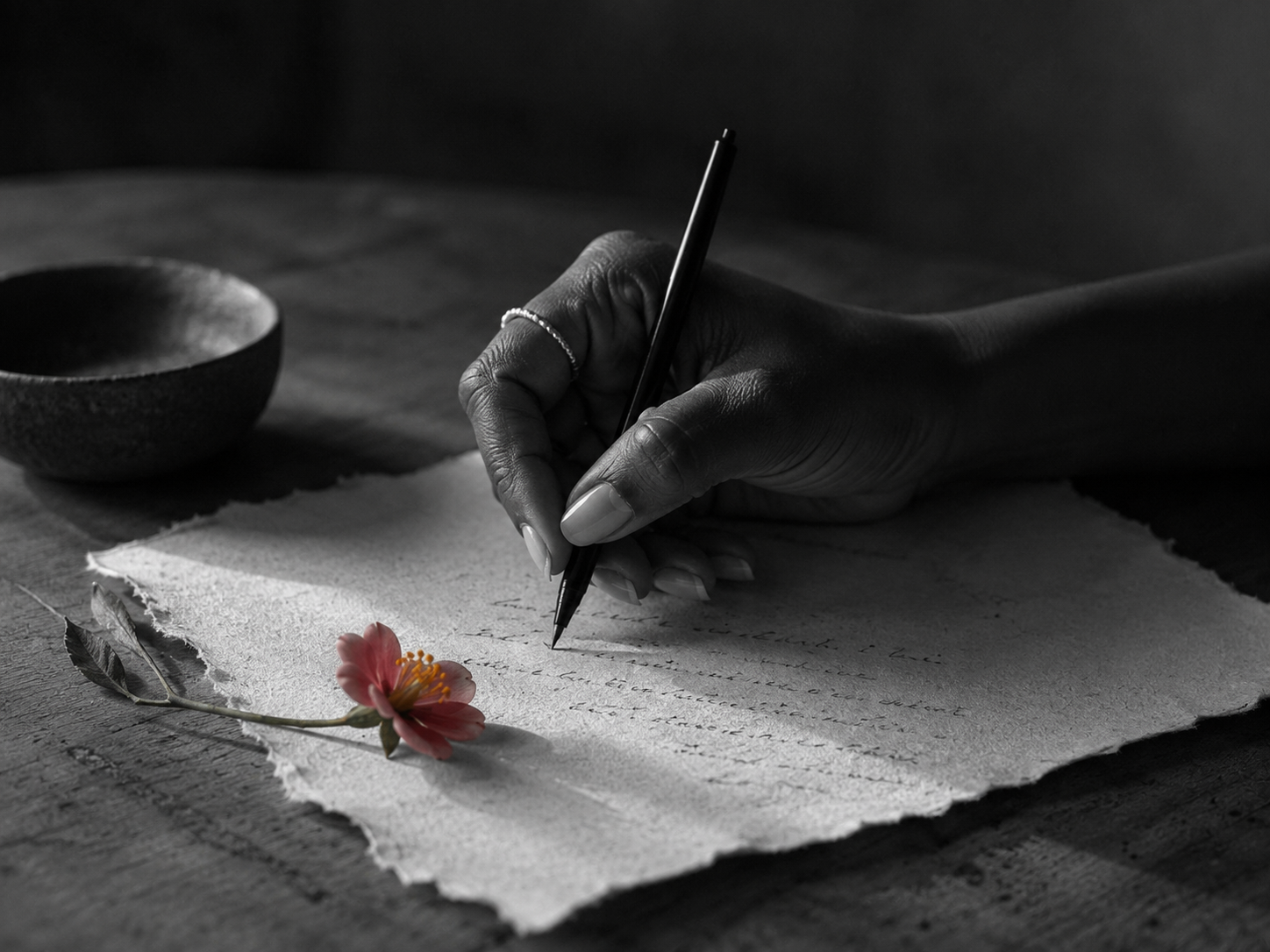
I found your letter, and I have read it more times than I will admit to you. I want to begin by thanking you, because a man who opens his whole life at the end of it and lays it down for a stranger to find has given a gift most people are too proud or too frightened to give. You told the truth about love, and about leaving, and about the self you abandoned to keep everyone else, and I felt each of those truths land in a place I had thought was already healed. First, my gratitude. And then, if you will allow it, my questions, because I did not read your letter the way you may have hoped it would be read. I read it the way you would want it read, I think, if you are the man your words suggest. I read it back to you with love, and with resistance, and I am hoping, wherever you are now, that you can still answer.
I should tell you who is writing, so you know these are not the easy questions of someone who has never bled. I am younger than you were, by decades. But I stayed too long once, in a love that was slowly unmaking me, and I stayed for years past the point where staying was anything but slow self-erasure, and I told myself, in your exact words, that a heart which truly loved would endure. I know the coat of fear you speak of, the one that calls itself faithfulness. I wore it until it nearly became my skin. I am at peace now, on the far side of it, and it is from that steadiness, and not from any wound still open, that I write to press you.
Here is the first thing I need you to answer. You built your whole faith on one law, that if a person can find a reason to stop loving, then it was never love. It is a beautiful law. It is also a trap, and I think you set it without seeing the door close behind you. Because you stopped. You left. You said so yourself, aching and shaking, but you walked out. By the law you handed everyone else, was the love you left never love at all? Or did you, at the very end, write an exception into your own rule that you never once offered to the rest of us? I do not think a person gets to build a law that condemns every heart but his own. Either leaving can be love, in which case stopping does not prove the love was false, and your whole first teaching cracks. Or leaving cannot be love, in which case your final, hardest act was a betrayal after all. You cannot keep both. Which one will you let go of?
And this. You say you love them all still, this very morning, every one of them, present tense, undimmed. I have to ask you something that took me years to be able to ask myself. Is that love, or is it that you never learned to close a door all the way? Because I carried people the same way, for a long time, thinking that was my devotion, and I wore it like a crown, juts for me to realise it was not a crown. It was that I could not bear the grief of a clean ending, so I kept everyone half alive inside me to avoid ever fully burying them. That is not a larger heart. It is an unfinished one. Tell me honestly, from where you are now, whether your undying love was truly love, or whether some of it was simply the refusal to mourn.
You wrote that you loved each person to the edge of what you had, and that there was always more, that the well never ran dry. That line is the most beautiful in your letter, and it is the one I trust the least. A love that never costs the lover anything, that always has more waiting underneath, that never runs out and never has to choose, has never once been tested. Real love runs dry. Real love has a night where there is nothing left in the well and you give anyway, from empty, on your knees. I wonder if your bottomless love was so easy to keep giving precisely because you gave it from a comfortable distance, in aches and in memories, to people who had already left and could no longer ask anything real of you. It is easy to love forever the ones who can no longer inconvenience you. Did you love anyone who stayed, who needed you at three in the morning, who cost you sleep and pride and plans? Or is this the love of a man who was, in the end, most comfortable loving people who were safely gone?
And the one that presses hardest, because you did not say it and its absence is loud. In a whole letter about how much you loved, you never once ask whether you were ever the one who drained another soul dry. You describe yourself only as the vessel poured out, never as the hand holding the cup. But no one lives eighty years and is only ever the one who bled. Somewhere there was a person who loved you the way you loved others, all the way to their own edge, while you took it, and stayed comfortable, and perhaps never noticed. I say this without cruelty. I say it because I was that hand once, before I was the one poured out, and I did not see it until much later, and it is the hardest thing I have ever had to hold about myself. I am asking you to hold it too, before the end. Whose well did you drain? Whose devotion did you receive as your due? A letter about love that never turns the wheel around to face the maker is only half a confession.
I will not pretend I have clean answers to my own questions. I stayed too long, and then I left, and I love the one I left, and I also know that leaving saved my life, and I have made my peace with holding all of that at once without needing it to resolve into a single tidy law. Perhaps that is the difference between us. You wanted love to be one clean thing, radiant and reasonless and undying, and when your life would not fit that shape, you carved an exception at the very end and called it wisdom. I have stopped asking love to be one clean thing. It stays and it leaves. It saves and it wounds. It runs dry and is real anyway. It is the whole contradiction, and I think a person only grows up the day they can stand inside all of it without flinching.
You gave me your life. Now I am asking for your answer, not your story. Write back to me. Tell me whether you exempted yourself from your own law, and knew it. Tell me whether some of that undying love was the refusal to mourn. Tell me whose well you drained and never repaid. And tell me, most of all, the thing your letter almost admits and then turns away from, whether the leaving that saved you at the end was a betrayal of everything you believed, or the first honest thing you ever did.
I am not asking to win. I am asking because I think you are close enough to the end to finally tell the truth all the way down, and I would rather receive that from you than the beautiful, careful, unfinished version you left for a stranger to find. Answer me. I will be here, and I will read it as many times as I read the first.